A federal judge ruled this week an 1855 treaty "cannot plausibly be read" to create a 337-square-mile Indian reservation on lands in a northern Michigan vacation-destination area. The Little Traverse Bay Band of Odawa Indians sued the state in 2015, claiming the 1855 Treaty of Detroit established its reservation on lands that now include Petoskey, Charlevoix and Harbor Springs, and it wanted the court to pave the way to create a reservation there.

View More →
Department of Health and Human Services officials are urging state residents to take greater care to protect themselves from mosquito bites after an outbreak of Eastern Equine Encephalitis has been detected in Kalamazoo and St. Joseph counties. While the two cases found both involve horses, neither of which was vaccinated and both have died, the disease can spread to humans. And while there is a vaccine for horses, there is none for humans. Earlier this month a woman infected with the disease died in Massachusetts.

View More →
4 states seek to identify flooding choke points on Missouri River. Officials in Iowa, Kansas, Missouri and Nebraska are calling on the Army Corps of Engineers to study bottlenecks that contribute to Missouri River flooding so alternatives can be suggested. "We're not going to go back to the years in the past, where all of the sudden once the flood's over we go back to the same practices, the same ways that we have always done things," Missouri Gov. Mike Parson said.

View More →
Louisiana's freshwater diversions, such as Davis Pond, are engineered to manage salinity, whereas sediment diversions like the ones proposed for Mid-Barataria and Mid-Breton are intended to reconnect the Mississippi River to wetlands, writes Bran Haase, executive director of the Coastal Protection and Restoration Authority. "Once built, these sediment diversions will enable us to rebuild and sustain tens of thousands of acres of coastal wetlands," he writes.

View More →
Another federal court has found the 2015 “waters of the U.S.” rule legally deficient, but language in the ruling could add another layer of controversy to the Trump administration's efforts to rewrite the rule. U.S. District Judge Lisa Godbey Wood in Georgia said in a ruling Wednesday the Environmental Protection Agency and Army Corps of Engineers overreached in defining their jurisdiction under the Clean Water Act, specifically in asserting federal authority over activities in interstate waters, tributaries and adjacent waters.

View More →
On the 115-acre property, billions of microbes do most of the work creating compost from waste generated by municipalities, industries, businesses and universities, including James Madison University and Virginia Tech.??High Plains Journal: Iowa Farm and Rural Life Poll shows conservation increasing.  As more land is rented in Iowa, tenants perceive an increase in their responsibility for conservation actions, but they are less likely to invest in conservation on the land they rent.

View More →

A September 2018 report by the U.S. Bureau of Labor Statistics found that while 85{74309160cd63eca64c36cfd96dc96b337e339df24e8f93d2cabc86a874012891} of workers at large private-sector establishments have access to 401(k) or other retirement plans, only 53{74309160cd63eca64c36cfd96dc96b337e339df24e8f93d2cabc86a874012891} of America’s small businesses offer the same opportunity.  Many small businesses cite costs and lack of administrative resources as prohibitive burdens.  Overall 38 million private-sector employees do not have access to a retirement plan through their employers.


View More →

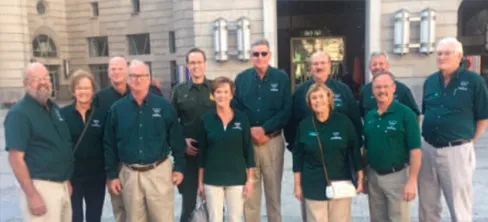
The National LICA Executive Committee held their annual meeting in Washington D.C. John Peterson, LICA Government Relations, arranged meetings with the Natural Resource Conservation Service (NRCS) and the Department of Interior. National LICA President, Brad McArdle, was able to schedule a tour of the Border Patrol with his son Clint McArdle, Assistant Chief. Clint has worked at the Border Patrol for 11 years.


David Pacheco, NRCS LICA Liaison, and seven of his colleagues, met with the Executive Committee. The requirements for LICA Members to become Technical Service Providers (TSP) was discussed at length. There was also a discussion on bettering relationships with state conservationists as well as the 2018 Farm Bill.


At the Department of Interior the committee met with Scott Cameron, Principal Deputy Assistant Secretary for Policy Management and Budget. There the committee brought up environmental impact statements and the lengthy approval process. They voiced their concerns about the various permits required when doing a job and how they can tie up a project for a long time.


The last stop of the day was the U.S. Customs and Border Protection at the Reagan Building. Clint McArdle met us and gave a detailed presentation about the Border Patrol. He has firsthand experience at the southern and northern borders of the United States.


The Executive Committee met on Saturday morning to get down to LICA business. During the meeting a variety of topics were discussed including the future of The LICA Contractor Magazine and the new publisher Scranton Gillette Communications. There will be two additional issues of the magazine and there are plans to revamp the national website. Scranton Gillette will also be publishing “The History of Farm Drainage” book, which will tell the history of drainage from as early as 200 B.C. to the present. We will research relevant information from every aspect of the industry.


The Residential Septic System Service Program was reviewed, and the different ways that contractors are promoting it. Some contractors are teaming up with septic associations while others are using realtors and home builders.


The overall feeling surrounding the Executive Committee Meeting was positive and all the Regional Vice Presidents and Officers are excited about the direction that LICA is going.